
Within the SIRCULAR project, different building typologies are being investigated with regard to circular renovation and construction. Among them is a distinctive building located on the Karlsruhe Institute of Technology campus. It represents a typology often used for campus and office buildings in the 1960s to 1980s. Buildings of this kind are becoming an increasingly pressing concern due to vacancy rates and renovation backlog. Dealing with them is a challenge that goes well beyond single projects and calls for a closer look at their characteristic architecture and underlying design principles.
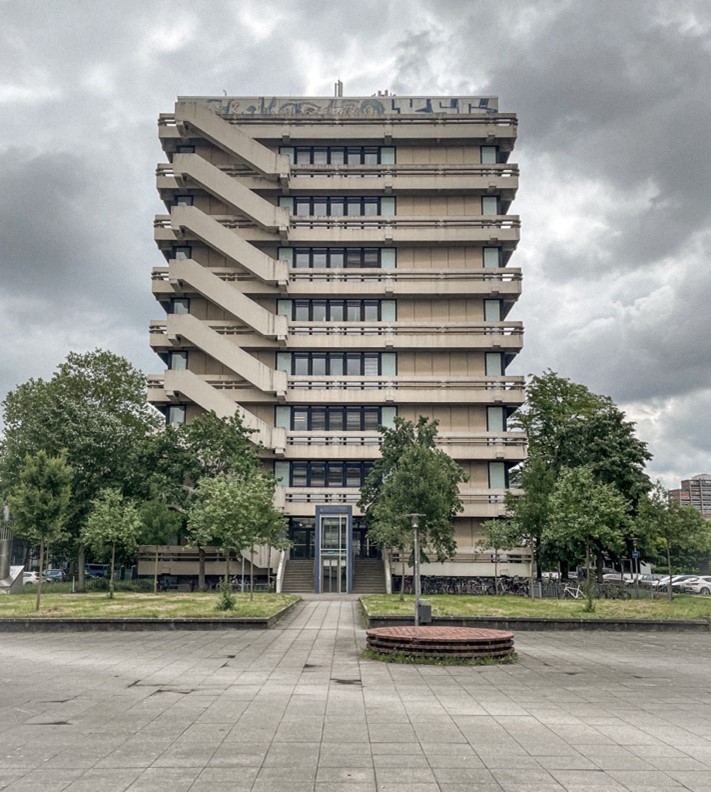
Standing in front of the building, it impresses immediately through its sheer size and austere design. A simple box, almost uniform on all four sides, nine floors rising above the ground, over a footprint of 40 by 25 meters. The outward appearance is dominated by access balconies that run continuously around the building and consist of prefabricated concrete elements, just like the rest of the building. It was erected in 1970 as “College Building III” and was intended to house offices, classrooms and laboratories for several departments in Civil Engineering at KIT. A new test hall for the Material Testing Institute (MPA) was erected right next to it in a lower building, connected by a corridor on the 2nd floor level.
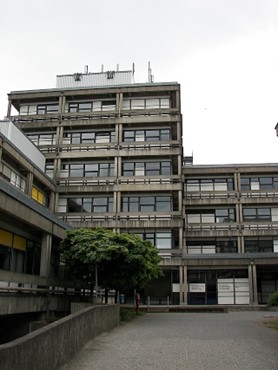
One only needs to compare it to other university campuses, built around the same time in Germany, to notice a striking similarity. Exposed concrete, the excessive use of balustrades and the skeletal appearance is something we also see in Marburg (Campus Lahnberge, 1964-1977), Darmstadt (Campus Lichtwiese, 1967-1978) and Bochum (Campus Querenburg, 1962-1974), to name a few examples.
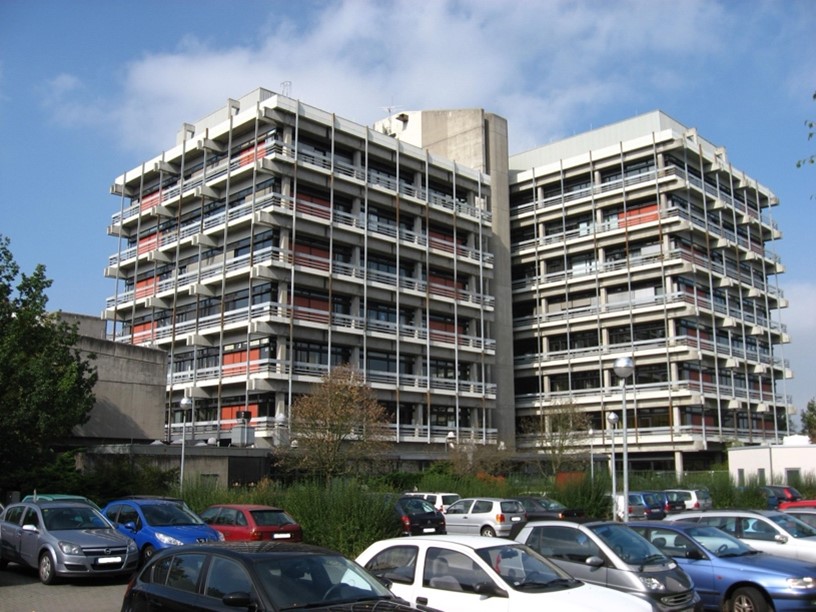
Their outward similarity owes to similar historical conditions and, resulting from this, shared constructive principles. Newly established universities like in Bochum, Bielefeld and Siegen created the opportunity to design and construct whole campuses according to the rationalist principles of the Modern era. The use of prefabricated elements promised the highest efficiency gains. Then, a sudden rise in student numbers toward the end of the 1960s, which the authorities had not anticipated, amplified the tendency to speed up and scale up construction.
Rapid building programmes were launched by the federal states, with whom responsibility for basic and higher education rested in the West German federal system. The prefabrication systems they made use of were either offered on the market, such as the Uniplan System developed by the company Imbau from Leverkusen. Or they were developed by the authorities themselves, such as the Marburger Bausystem, which today is the most well-known of them.
Figures from the state of North Rhine-Westphalia give us an impression of the sheer scale and speed that were accomplished: The programme was started from scratch at the end of 1969 and was intended to create 30,000 square metres of usable space and workplaces for up to 5,000 first semester students by the start of the 1970/71 winter semester, i.e. in less than a year. According to the architects, planning as well as construction were finished within just eight months.
The KIT college building made use of the Uniplan system, which was employed for the first time in the state of Baden-Württemberg for the construction of colleges for education (Pädagogische Hochschulen). Uniplan offered frame construction on a 7.2 x 7.2 metre grid. The joists extended beyond the building envelope and the balcony elements could simply be placed on top of them, creating the typical outward appearance characterised by concrete joist heads and railings.
The context-independent rigour of prefabricated systems met with criticism. According to architect Bruno Lambart, who in 1971 had to use Uniplan for a college building in Dortmund, such building systems were eventually detrimental to both the user and the building’s environment. Nowadays, it is often difficult to determine whether their design was influenced more by conscious decisions, adherence to building regulations, or the constructive needs inherent in the system.
Other architects believed that the right building system would not only overcome those flaws, but also remedy many other shortcomings. Günther Moewes, who worked for the British prefab construction company Brockhouse at the time, recalls:
‘Even back then, we believed that buildings should be constructed without generating construction waste, require little maintenance and be constantly adaptable. All parts should be dry mounted, easy to disassemble and reuse’.
Today, SIRCULAR is working on exactly these critical issues. For the building on the KIT campus several renovation strategies are being developed and assessed comparatively. Given the historical significance of its architectural design and construction methods treating the building’s fabric with care is key, when aiming to optimise criteria like energy performance, grey energy and usability.
This article was written by Paul Friedl, ZRS Architekten
Photo Credits:
Figure 1: KIT / Natascha Steiner
Figure 2: Wikimedia Commons CC-SA-1.0 / https://commons.wikimedia.org/wiki/File:Uni_Marburg_Lahnberge_04.jpg
Figure 3: Wikimedia Commons CC-BY-SA 4.0 / https://commons.wikimedia.org/wiki/File:TU_Darmstadt_L202.jpg
